Digital Impressions: A Better Way to Map Your Smile
Impressions have traditionally involved making a mold of your teeth using trays filled with a soft, messy, and often bad-tasting material that would harden around the patients’ teeth and gums, creating a precise model that is then used by the doctors and the lab to plan treatment and create final restorations.
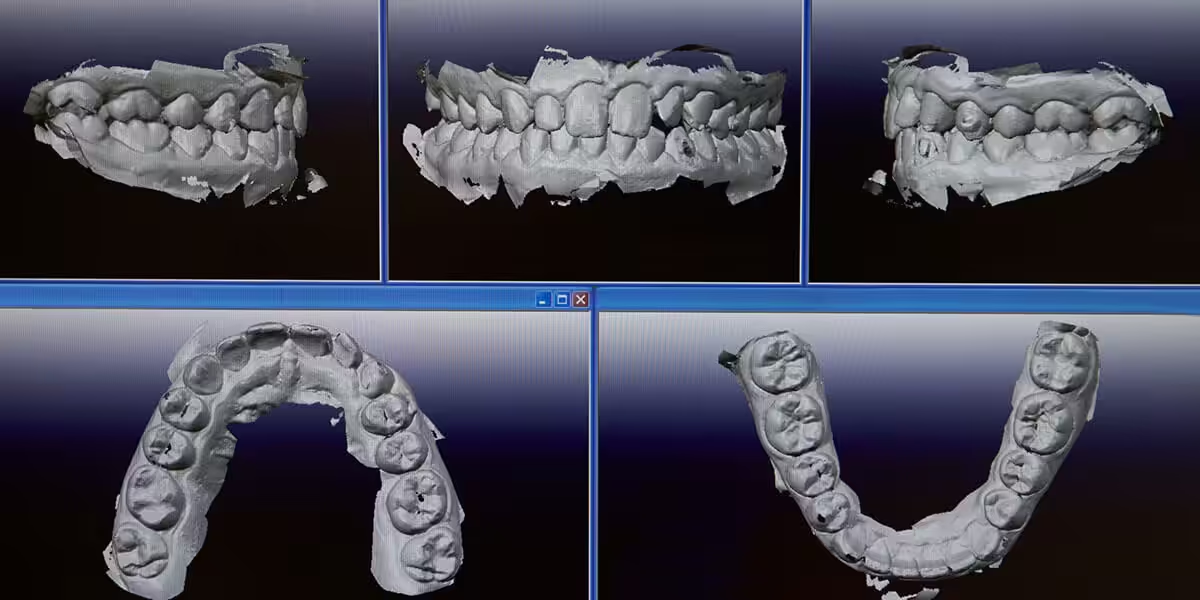
The digital intraoral scanner provides a new, comfortable, and precise way for our office to take digital impressions of patients’ teeth. Taking accurate impressions of a patient’s teeth is a highly important part of a large number of dental and orthodontic procedures.
Call 703-449-8888 to schedule an appointment in one of our readily available offices today!
Why Digital Scanning Is More Comfortable
The most immediate difference patients notice is how much easier the experience feels. There’s no tray pressing against the roof of your mouth, no goopy material to swallow around, and no waiting for anything to harden. Because the scanner is just a small camera, people with a sensitive gag reflex, children, or anyone who has dreaded dental impressions in the past tend to handle it much better. If the scanner misses a spot or you need to pause, your dentist can simply rescan that one area rather than starting the entire impression from scratch — which is a common frustration with traditional putty impressions, where a single air bubble or pull can mean redoing the whole tray.
Accuracy and Treatment Benefits
Peer-reviewed research has shown that digital scans deliver accuracy that matches — and in some cases exceeds — conventional impressions for crowns, bridges, and short-span restorations, while offering patients a clearly better experience in terms of comfort and chair time. Traditional impression materials can distort slightly as they’re removed, shipped, or poured into stone casts, and even small inaccuracies can show up later as a crown that doesn’t seat quite right. Digital files don’t shrink, warp, or degrade in transit. For larger or more complex cases, such as full-arch restorations, your dentist may still choose a traditional impression or combine methods, since the evidence on long-span accuracy is still evolving. Beyond precision, the digital file can be sent to the lab instantly, often shaving days off turnaround time, and the 3D model on the screen gives you a chance to actually see what your dentist sees — which makes it easier to understand your treatment plan and what the end result will look like.